
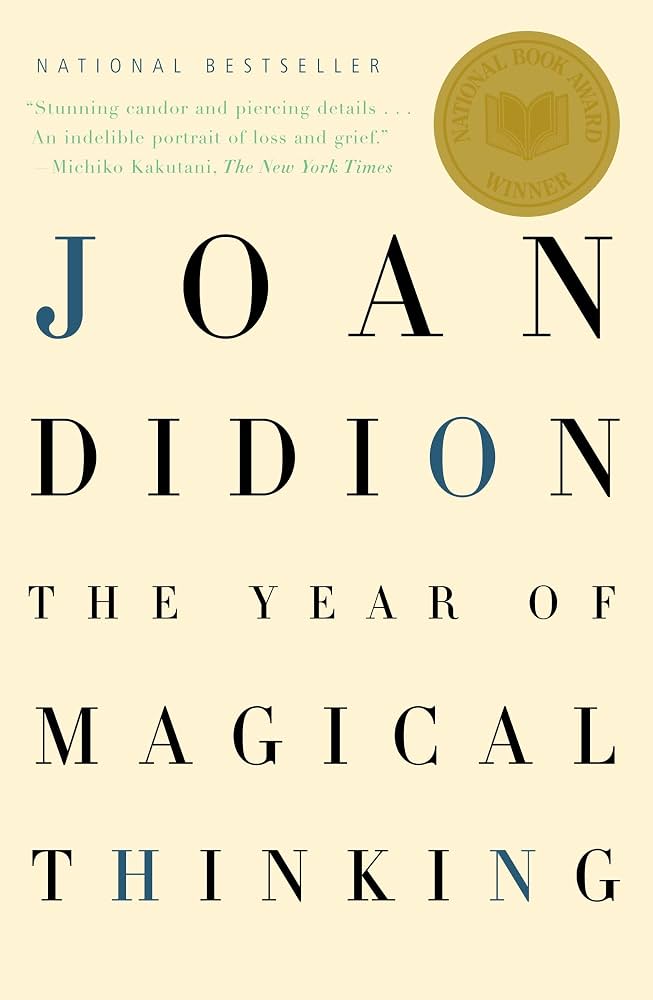
I received an email from the San Diego Public Library that my book was due tomorrow and could not be renewed. “The Year of Magical Thinking” by Joan Didion had been sitting on my dresser, along with other library books I had not gotten around to yet, for apparently two weeks. I had meant to pick it up sometime soon, but kept promising myself I would get around to it as soon as I finished Flaubert’s “Madame Bovary,” however long that would take. The other library books that had been sitting there longer than two weeks knew this story all too well.
Suddenly stressed because I still wanted to read it and it now had a ticking timer on it, I decided to pick it up and read it in one night. It was already midnight by the time I even saw the email, so I knew I had a long night ahead of me. Already committed to the task, I checked the page count; 227 didn’t seem too bad for a night’s worth of reading. I sat myself down and began combing through the pages—resulting in a wonderful night with me, Didion, and the beautiful Bodoni font you could recognize her writing by.
“This is my attempt to make sense of the period that followed, weeks and then months that cut loose any fixed idea I had ever had about death, about illness, about probability and luck, about good fortune and bad, about marriage and children and memory, about grief, about the ways in which people do and do not deal with the fact that life ends, about the shallowness of sanity, about life itself.” After the loss of her husband, John, and her daughter’s simultaneous and frequent hospital visits close to the turn of the year 2003, Didion navigates the following new year in the destabilizing stages of grief. Through cycles of reanalysis and plenty of wishful thinking, her recount of such a harrowing time serves as a deep exploration of human memory in times of loss and grief—how do we process life-altering loss, and how do we remember it? Didion shows her vulnerability in these pages, cycling through her memories of the time when it happened and their shared past, questioning her own strength, believing in writing as a way of processing. The repetition that occurs through the recycling of her memory is enough to carry meaning, and Didion has always believed that “The way I write is who I am, or have become”—in truth, there is no regard for padded language or convoluted structures. Here is what I think. And that is what it means. “Was it only by dreaming or writing that I could find out what I thought?”
I am no stranger to the idea that losing someone is also losing the version of you that knew them. “We are imperfect mortal beings, aware of that mortality even as we push it away, failed by our very complication, so wired that when we mourn our losses we also mourn, for better or for worse, ourselves. As we were. As we are no longer. As we will one day not be at all.” Grief is always confusing; as the heaviness in your heart longs for the person you lost to come back, you have to continue living with the hollow spot they left in it. The heavy and hollow feeling follows you around, and you have to learn how to balance. Yet, however grim that sentiment may seem, it also leads to growth. There is not as much sadness in these pages as one would expect, and instead it just left me with the fascinating questions of how we choose to remember things and how we choose to grow.
Witnessing just a fraction of the thoughts, details, and emotions that can occur to one single person in the span of a year in just my night’s worth of reading made me marvel at how much can truly happen in a year. When I put the book down, I started to think about how much I’ve grown in the past year; I’ve entered and left new chapters in my life, I’ve forged new relationships while growing out of old ones, I’ve cried, laughed, broken down, reached new heights. There is so much space for things to happen and so much room to grow if you look forward and allow that space to fill.
 Angelina Rosete
Leave a comment